Family Portrait
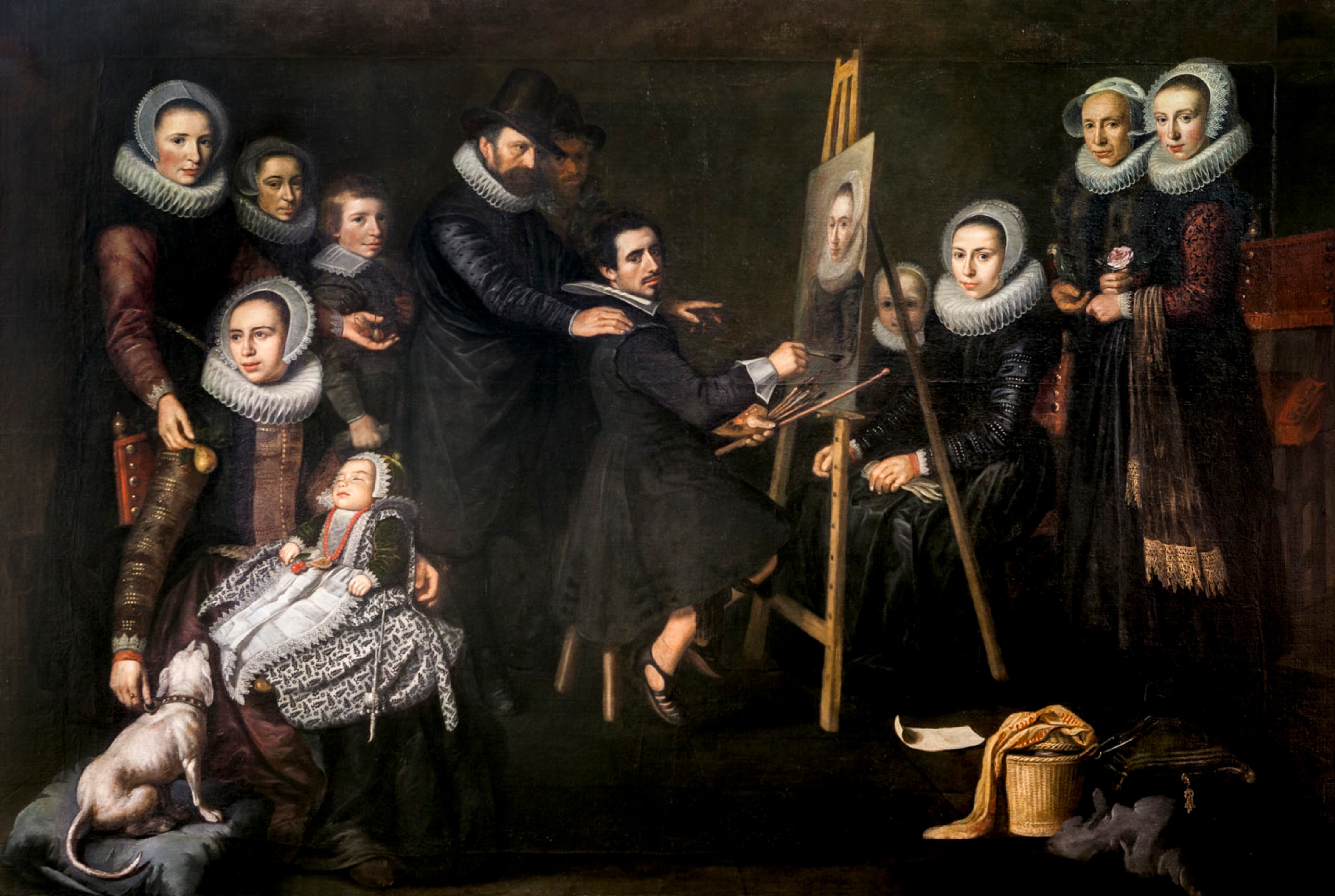
Attributed to Pieter van Mierevelt, between 1617 and 1619, oil on canvas.
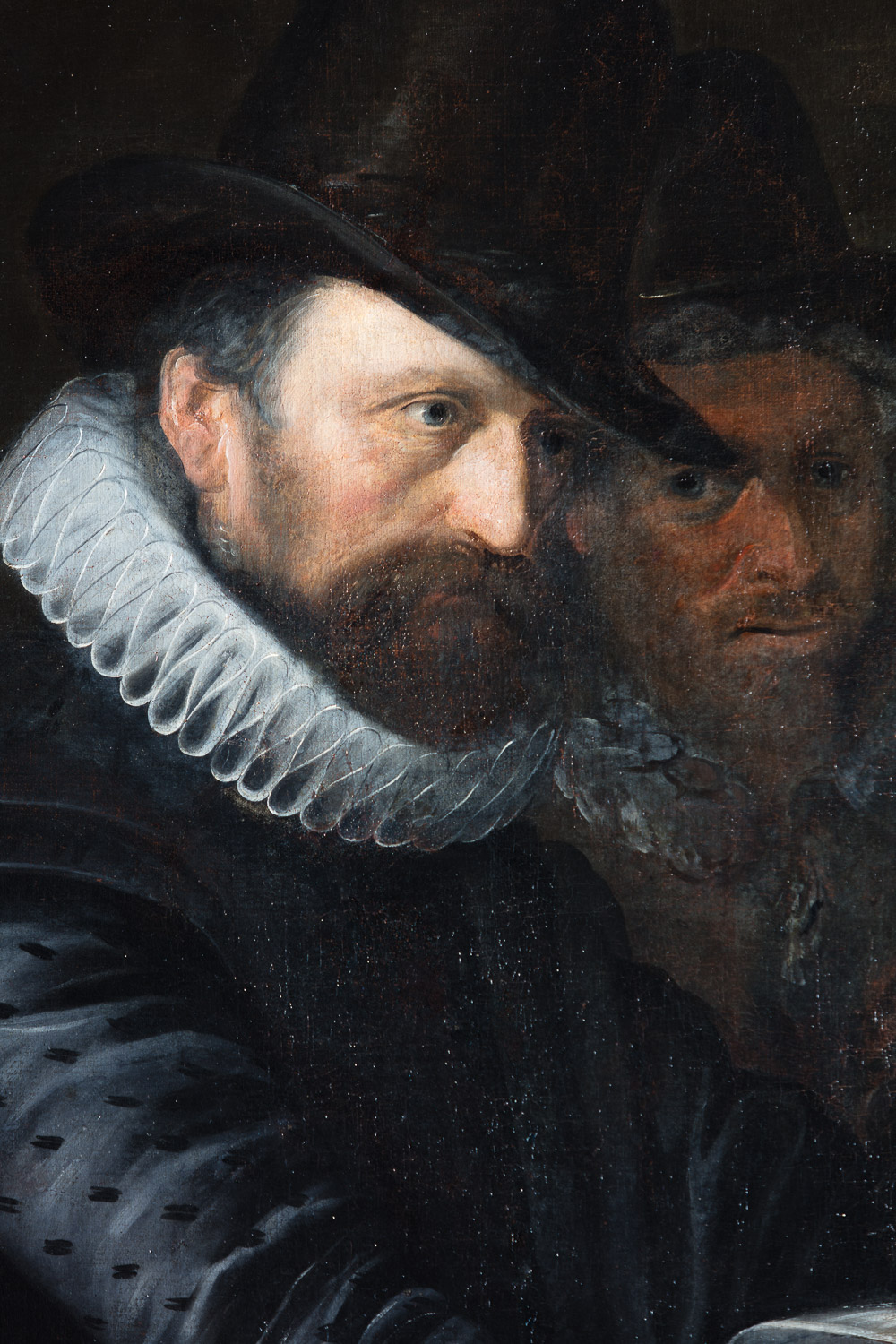
This is a large format painting depicting twelve people.
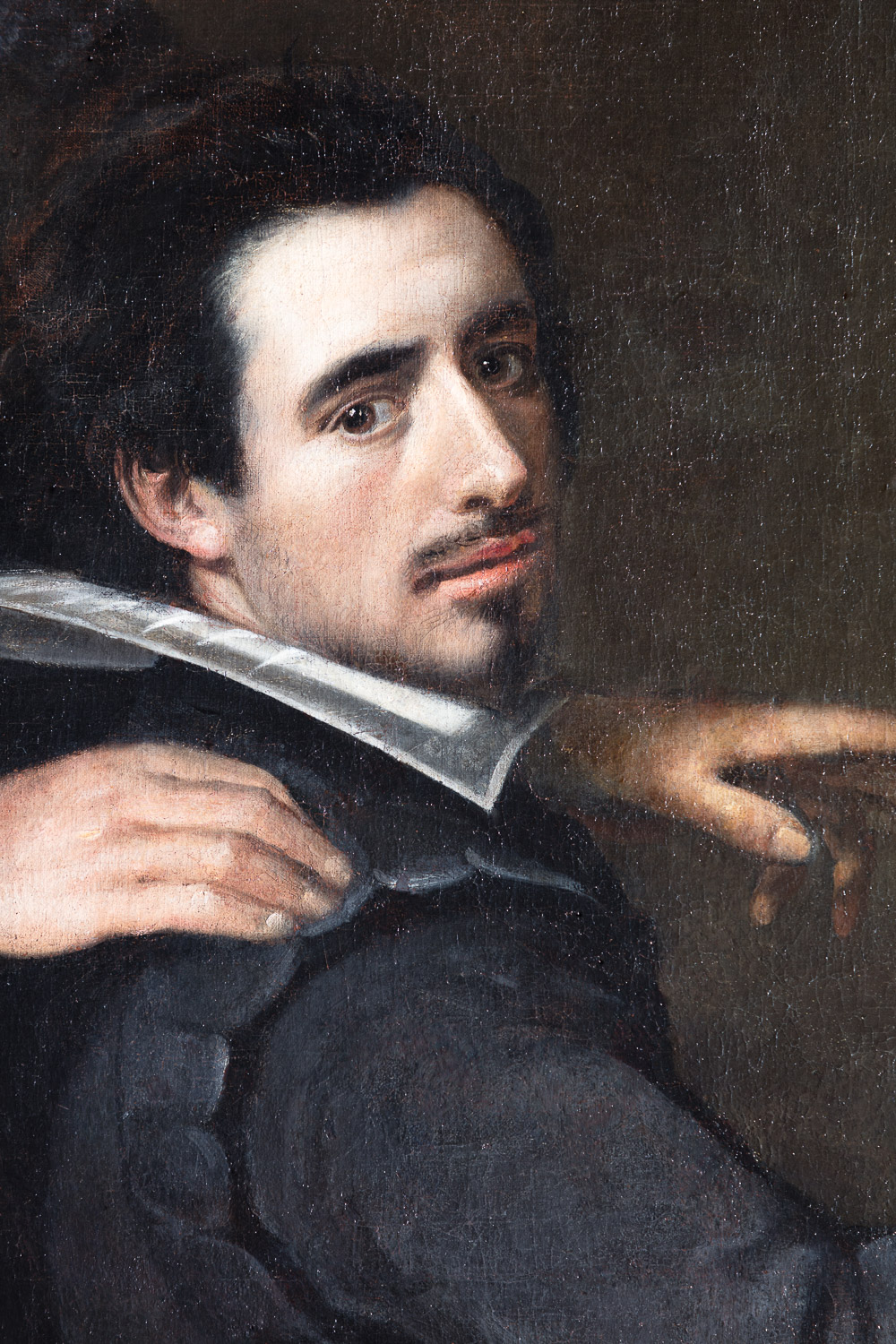
The centre of the composition is taken up by the representation of a painter seated and facing his easel. An older person is depicted standing behind the artist, his right hand on his shoulder and his left hand indicating the painting that is being created.
History:
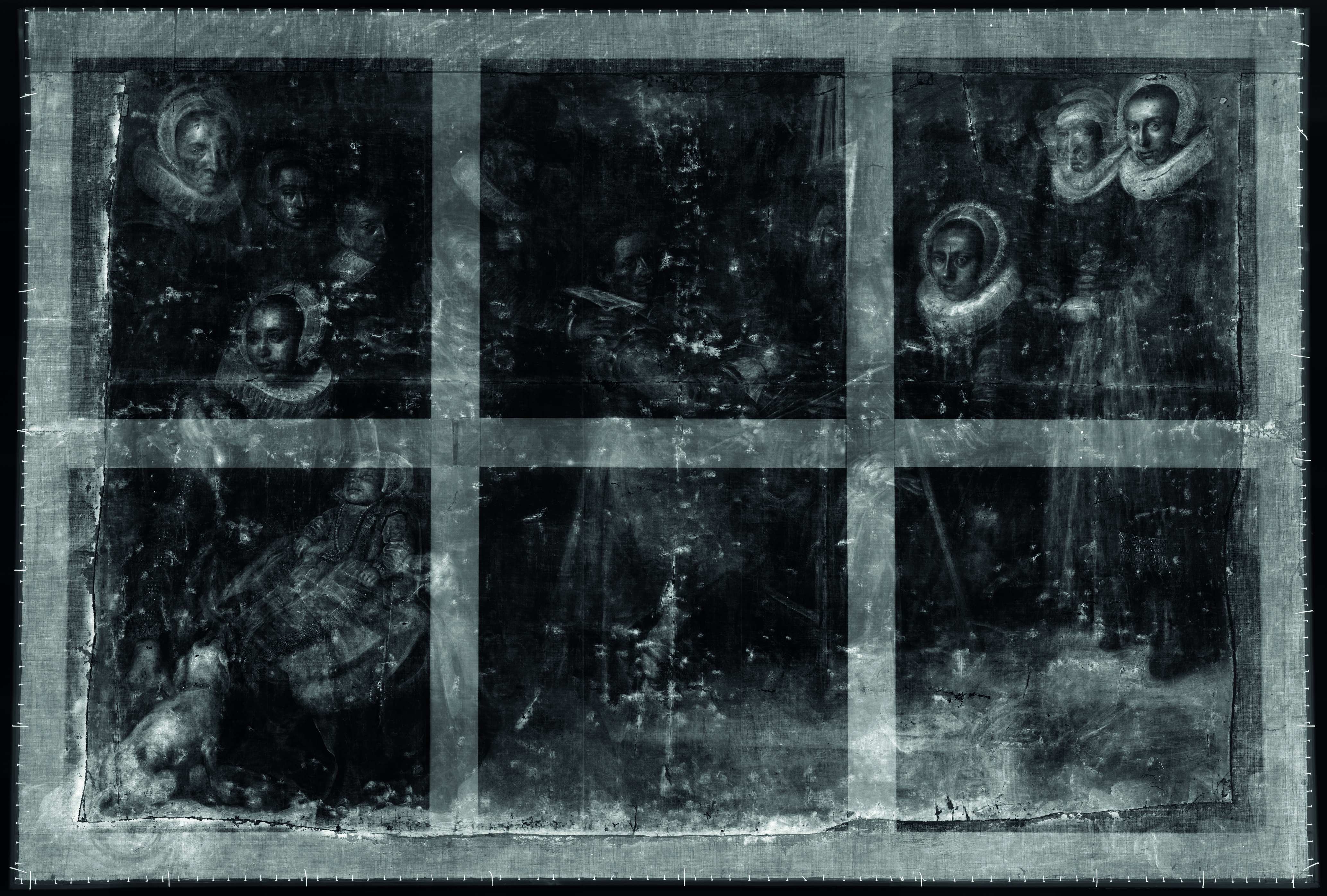
This is a portrait of the family of Michiel van Mierevelt (1567-1641), a Dutch painter famous for his portraits. His atelier was located in Delft. Thanks to restoration of the work carried out by the Royal Institute of Artistic Heritage (in French, IRPA), we now know that four of the figures were not present in the original painting but were added later.
The central figure is Pieter van Mierevelt, who is working on the portrait of his sister Ariaentgen. Behind him is his father, the famous painter Michiel van Mierevelt. Farther back of Ariaentgen stand her mother Stijntge van der Pes and her sister Maritgen Cleophas. The little girl whose face is hidden by the easel is probably Maritgen, the eldest daughter, who died in 1595 at the age of four. The head of the man sketched in the background is most likely that of Willem Delff, who, in 1618, married Geerten, the daughter of van Mierevelt. Behind the father we can see Jan, the youngest of the sons. Then there is an added figure, most likely Aechgen, who died in 1608, and, visible on the far left of the painting, the portrait of Commertge. Finally, seated in the foreground is Geerten van Mierevelt with grandson Jacob Delff, born in 1619, seated on her knees.
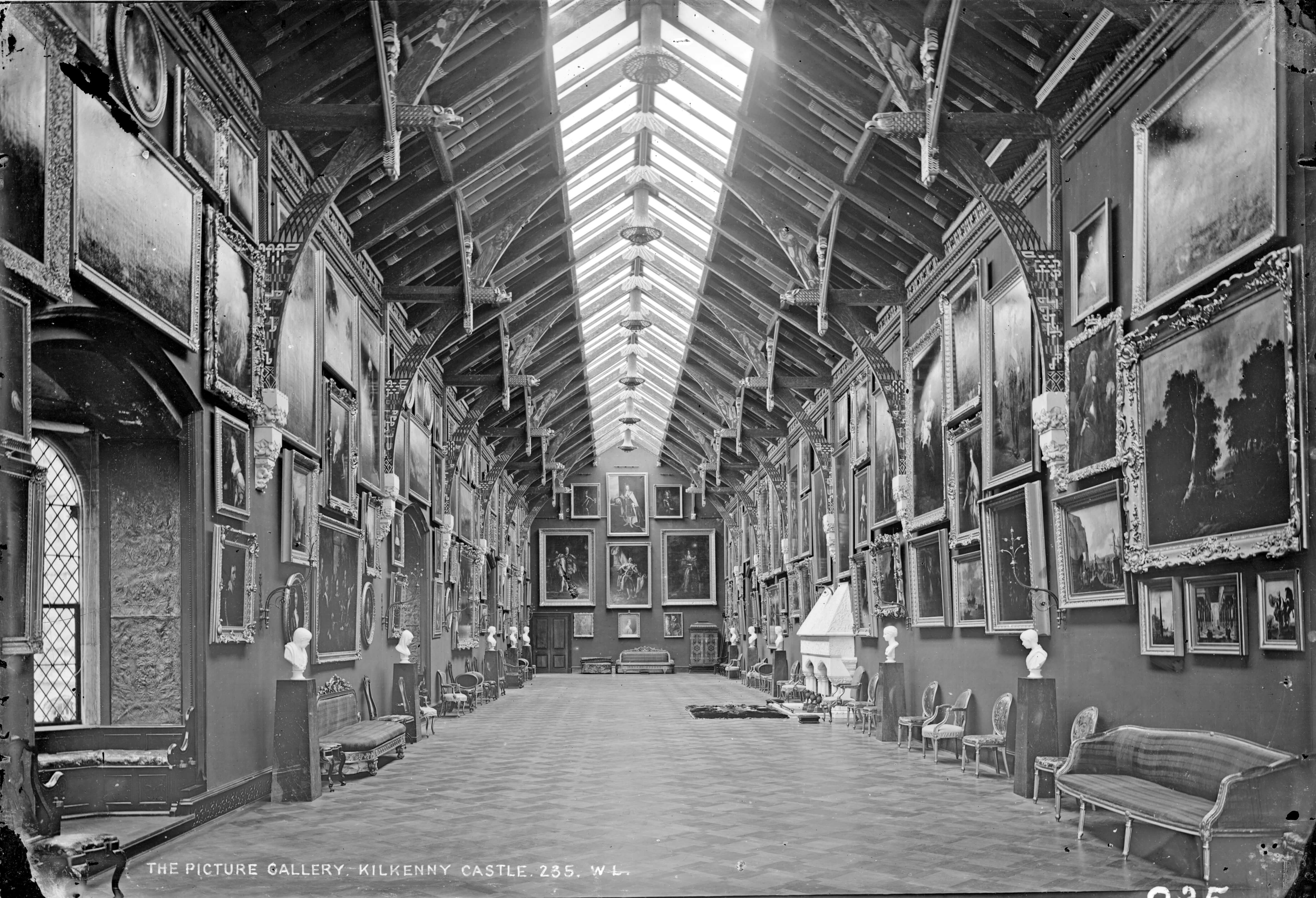
An inventory of the possessions of Michiel van Mierevelt was taken shortly after his death in 1641. This list mentions a series of paintings including “a large painting of Michiel van Mierevelt’s entire family, painted by Pieter van Mierevelt, unfinished.” The work described remained lost for three and a half centuries until a large Dutch painting, a part of the collections of Jehay Castle, the property of the Province of Liège, came to the IRPA for restauration in 2004. Research undertaken by Pierre-Yves Kairis, at the time an art historian at the Royal Institute for Cultural Heritage, made it possible to identify this work as the one mentioned in the inventory of the van Mierevelt family in 1641. The Family Portrait was, it seems, bequeathed to Commertge, the daughter of the painter, then passed down to the following generations. It was eventually sold, perhaps during the 18th century, before finding itself, probably not without some twists and turns, hanging in the great gallery of Kilkenny Castle in Ireland. Rudi Ekkart has hypothesised that the painting was purchased by John Butler, 2nd Marquess of Ormonde, an important art lover and collector.
Interpretation:
There are very few examples of Dutch paintings from the 17th century where the painter depicts himself at work surrounded by his family.
This iconographic decision propels us into the scene that comes to life before our eyes and takes time to unfold. We can feel the time pass: the gestures and their meanings place the portrait into a long temporal perspective. It is a question of demonstrating through an image that family ties are capable of enduring over time, of even going beyond the perspective of mere individuals. That is why the deceased and the living are present in the same image, thereby bringing together in a single moment destinies that are otherwise definitively separated. Death itself is powerless against the family.
The most important detail in this work by van Mierevelt is clearly the father’s hand on the son’s shoulder. This gesture expresses the confidence in the capacities of the son to carry on the work of the father. It designates, in a matter of a few brushstrokes, the importance of heritage and fidelity between the successive generations of the family. This contact does not only indicate the perpetuation of professional expertise, but also trust in the strength of ties of affection.
The work evokes the universal theme of the relationship between a father and son. Michiel’s attitude is a positive response to this great human question: are sons always condemned to walk in the footsteps of their fathers? There is a poignancy in knowing that, in an ironic twist of fate, the father outlived the son, who was cut down in the prime of his life. Heritage was thus a brief affair. Our knowledge of Pieter’s destiny confers upon the portrait the signification of a vanity: Ars longa, vita brevis (“Art is long, life is short”, as the Greek Hippocrates put it).
Restoration:
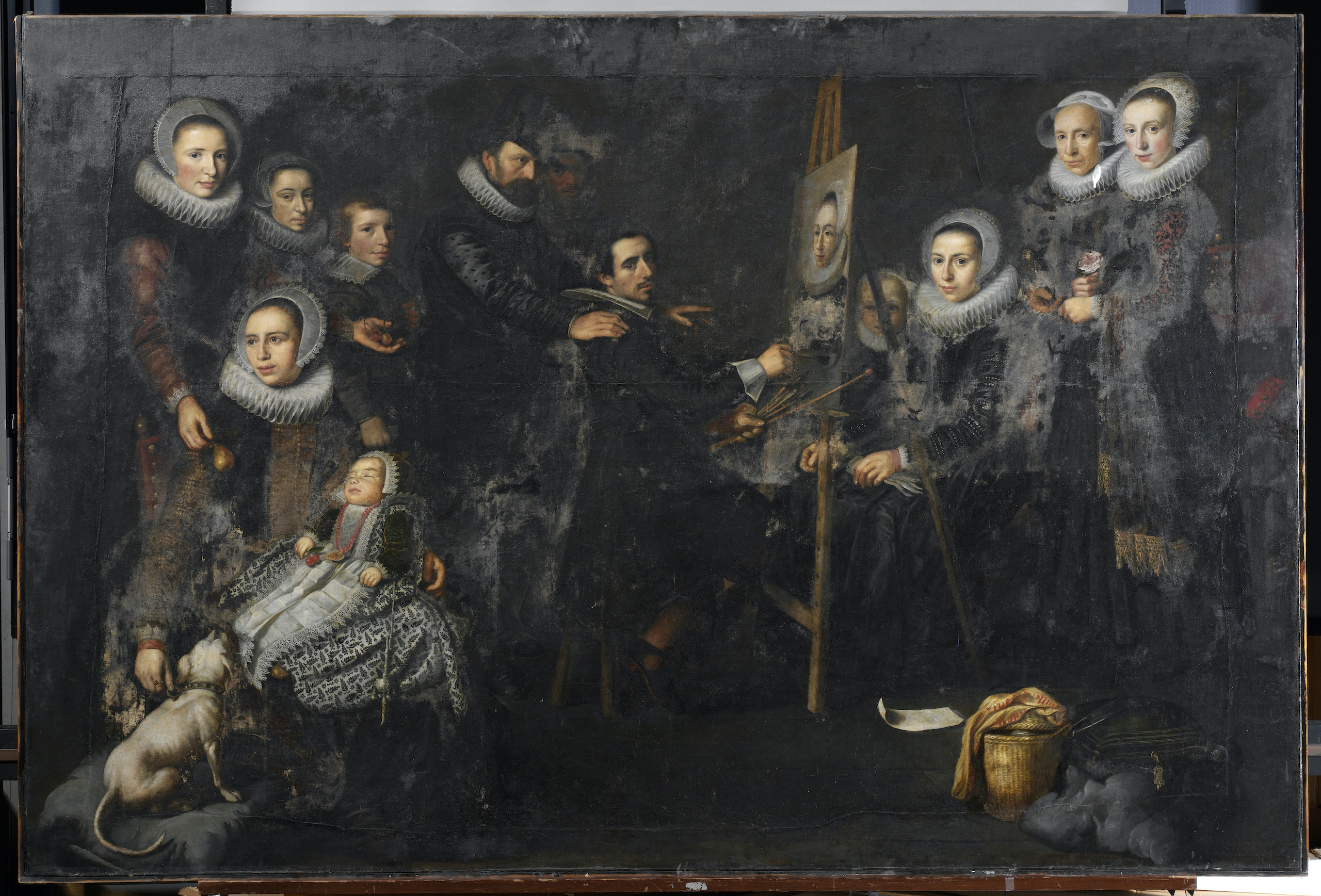
The Family Portrait was restored by the Royal Institute for Cultural Heritage between 2004 and 2007. A multidisciplinary study carried out concerning this work made it possible to not only to place it in a historic context and determine its provenance but also to identify its material history. Upon its arrival at the IRPA, the painting was in poor condition, with large areas of mould making the composition almost illegible. An x-ray of the work allowed one to understand its technical history and to isolate three restauration campaigns prior to 2004. The second restoration campaign probably took place after the canvas was cut out from its frame, which was undertaken rapidly and without care. Perhaps this was done to quickly save the work from a fire, or perhaps to steal it. It is also true that the canvas was folded in two and perhaps rolled up for an indeterminate amount of time. The family attempted to sell the painting in 1926 and, it seems, sent it to London. It is possible that the work was detached from its stretcher and rolled up for this journey.
The painting presents differences in quality in various parts and appears unfinished. Examination of the painting tends to prove that the Family Portrait was the work of several hands. Undertaken in large part by Pieter van Mierevelt, with the help of his father in certain areas.